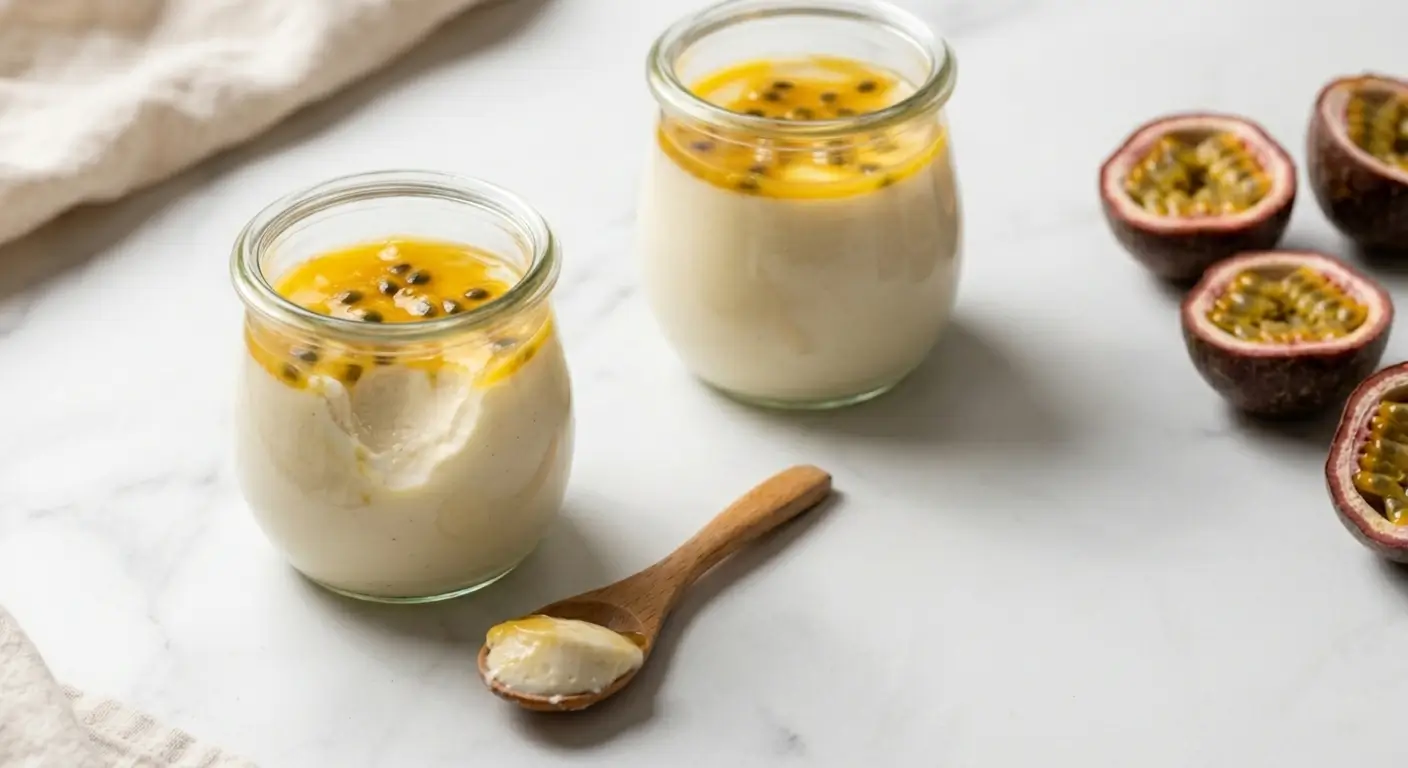
Coconut Panna Cotta with Passion Fruit Coulis Recipe
Before you start:
- You need at least 4 hours of fridge time. Overnight is better. Plan accordingly.
- Full-fat canned coconut milk only. Not the carton. Not “lite.”
- Active prep is about 15 minutes. The rest is waiting.
- This makes 4 portions and doubles cleanly if you’re feeding a crowd.
Why I keep making this
I started making this a few years ago after a dinner party disaster. I’d planned a chocolate tart, miscalculated the timing, and ended up serving slices that were more molten than set. Nobody said anything. I said something. It was a whole thing.
After that I got serious about desserts I could actually trust. Coconut panna cotta with passion fruit coulis is now the one I default to when I’m cooking for people. I make it the night before, it sits in the fridge, and I take it out when I’m ready. Nothing wobbles. Nothing collapses. There’s no dramatic reveal moment where you hold your breath.
It’s also genuinely simple. One saucepan. Four ingredients in the panna cotta. The passion fruit coulis takes maybe six minutes. If you can stir a pot and set a timer, you can make this.
I’d call it a weeknight dessert, except I mostly make it when I have people coming over because it looks nicer than the effort involved. For a dinner party, you can prep everything up to two days ahead. For a regular Tuesday, you make it after work and eat it the next night.
How to make coconut panna cotta with passion fruit coulis
Work slowly on the gelatin step. Rush that and nothing else matters.
- Pour 3 tablespoons of cold water into a small bowl. Sprinkle 2 teaspoons of powdered gelatin over the surface. Don’t stir. Leave it for 5 full minutes. It’ll look spongy and a bit strange. That’s what you want.
- Put 400ml of full-fat coconut milk, 120ml of heavy cream, and 3 tablespoons of caster sugar into a medium saucepan. Warm it over medium-low heat, stirring now and then, until the sugar dissolves. You’re looking for steam, not bubbles. Don’t let it boil.
- Take the pan off the heat. Add the bloomed gelatin and stir for about 60 seconds until it’s completely dissolved. You shouldn’t see any granules. Add 1 teaspoon of vanilla extract and taste it. Add more sugar if you want it sweeter.
- Pour the mixture through a fine sieve into a jug. Divide evenly between 4 lightly oiled glasses or ramekins.
- Let them cool to room temperature, then cover with cling wrap and refrigerate. Minimum 4 hours, but I’d push for overnight if you have the option. The texture genuinely improves.
- For the coulis: scoop the pulp of 6 passion fruits into a small saucepan. Add 2 tablespoons of sugar and 2 tablespoons of water. Cook over medium heat, stirring, for about 4 minutes until slightly thickened. Taste it. Add sugar if the fruit is very tart, a squeeze of lime if it needs brightness. Strain out the seeds if you want a smooth sauce, or leave them in. Cool before using.
- Spoon the coulis over each panna cotta just before you serve. If you’re unmolding from ramekins, run the dish under warm water for about 10 seconds, run a thin knife around the edge, and invert onto a plate.
The most important thing to get right is step 1. If the gelatin doesn’t bloom properly, it won’t dissolve cleanly into the warm liquid. You’ll end up with small rubbery bits in the finished panna cotta, and no amount of straining fully fixes it. Five minutes. Cold water. Don’t rush it.
Timing note: 15 to 20 minutes of actual work, then 4+ hours hands-off. It depends on fridge temperature and how deep your individual portions are. Deeper glasses take longer to set in the middle.
Tips that actually matter
Use full-fat canned coconut milk. I know I said this already. I’m saying it again because it’s the one thing that causes the most failures. Light coconut milk has more water in it, which throws off the gelatin ratio. The panna cotta will be loose and slightly weepy. The carton version sold as a dairy alternative is even worse for this, it’s basically coconut water with some emulsifiers and won’t set at all. Buy the can. Shake it before you pick it up in the store. A good can feels heavy because the fat is solid. If it sloshes like liquid, put it back.
Don’t let the coconut milk boil. High heat breaks the emulsion, and the finished panna cotta can end up slightly grainy. Medium-low heat. You just need the mixture warm enough to dissolve the sugar and the gelatin.
Strain before you pour. Even when you do everything right, there can be small undissolved bits or coconut solids. A fine sieve takes 20 seconds and guarantees a smooth result.
Make the coulis the day before or right before serving. Fresh passion fruit coulis loses its sharpness after two or three days. I usually make it in the morning if I’m serving at dinner.
For coconut panna cotta with passion fruit coulis that you’re planning to unmold onto plates, oil the ramekins lightly before pouring. Just a thin wipe of neutral oil with a paper towel. It makes the unmolding much cleaner.
“I made this for a dinner party of eight and prepped everything the night before. Honestly the easiest dessert I’ve ever served to guests. It looked fancy enough that people asked for the recipe.” — Nadia, who taught me the oiled ramekin trick
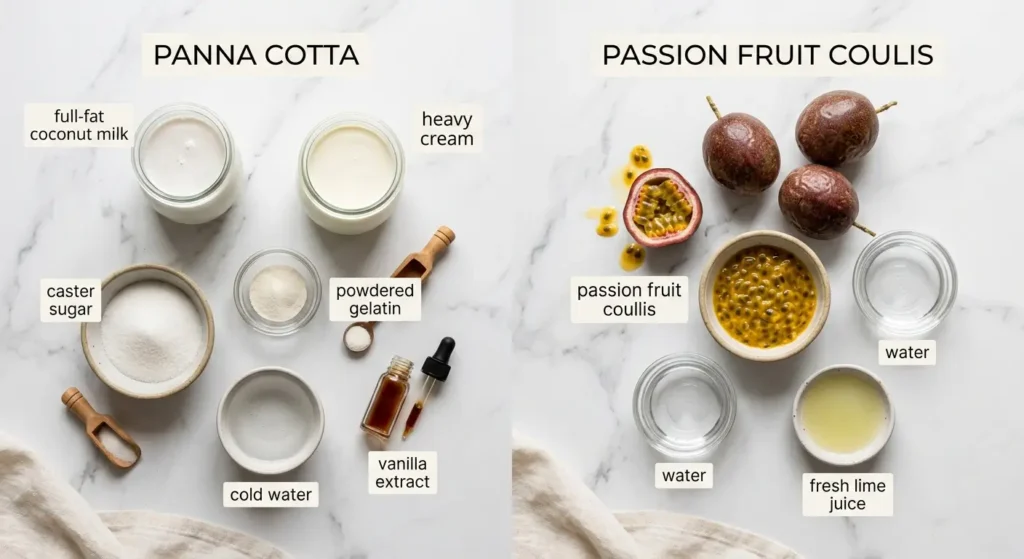
Ingredients
You probably have most of this already. Nothing obscure.
For the panna cotta (4 servings):
- 400ml full-fat coconut milk (1 standard can)
- 120ml heavy cream
- 3 tablespoons caster sugar
- 2 teaspoons powdered gelatin (about 7g, one standard sachet)
- 3 tablespoons cold water
- 1 teaspoon vanilla extract
For the passion fruit coulis:
- 6 ripe passion fruits
- 2 tablespoons caster sugar
- 2 tablespoons water
- Squeeze of lime juice (optional)
If passion fruit is expensive or out of season where you are, ripe mango works well. Blend about 150ml of mango with a tablespoon of lime juice and a little sugar. It’s sweeter and less tart than passion fruit, but it pairs naturally with coconut. You can also do a simple raspberry coulis. Cook frozen raspberries with sugar and a tablespoon of water, strain, done.
If you need this dairy-free, replace the heavy cream with more coconut milk. Use 520ml of coconut milk total. The panna cotta will be a touch softer and more purely coconut in flavor, which isn’t a bad thing.
On buying coconut milk: avoid anything labeled “light,” “reduced fat,” or “coconut beverage.” The refrigerated carton versions sold next to oat milk are not the right product. You want canned, full-fat, ideally with a short ingredient list: coconut, water, and maybe a stabilizer like guar gum. That’s it.
Variations worth trying
Lime and ginger. Add the zest of one lime and a teaspoon of finely grated fresh ginger to the warm coconut milk before you strain it. The ginger is subtle in the finished dessert, just a faint warmth at the back. Skip the passion fruit coulis and serve with a fresh mango salsa instead. Good alongside Thai food or anything that was spicy.
Pandan. Bruise 2 or 3 pandan leaves and drop them into the saucepan while the coconut milk heats. Pull them out before straining. The panna cotta comes out pale green and has a toasty, faintly floral smell. Serve with the passion fruit coulis or a drizzle of sweetened condensed milk. If you’ve never cooked with pandan before, this is a good introduction.
Coffee coconut. Dissolve a tablespoon of instant espresso into the warm coconut milk before adding the gelatin. The bitterness cuts through the richness well. I serve this with a dark chocolate sauce instead of the passion fruit. Good after a heavy dinner when you want something that doesn’t feel too sweet.
Lemongrass. Bruise two lemongrass stalks and simmer them in the coconut milk for five minutes before straining. The flavor is delicate. Serve with sliced fresh strawberries and a small amount of black pepper. Better than it sounds.
Chocolate swirl. Melt 40g of dark chocolate into half the coconut milk mixture. Pour the plain and chocolate versions into glasses in alternating layers, letting each layer firm up in the fridge for 20 to 30 minutes before adding the next. Takes longer but looks impressive. No coulis needed.
One practical note: if you’re adding anything acidic like fresh citrus zest or juice directly into the panna cotta mixture, test a single portion first. Acid can interfere with how gelatin sets, especially in large amounts.
Storage and leftovers
Cover each portion tightly with cling wrap, pressing it gently against the surface so a skin doesn’t form. They keep in the fridge for up to 3 days. After that the texture gets rubbery and the flavor goes flat.
Don’t freeze panna cotta. The gelatin structure breaks down during freezing and the texture after thawing is grainy and watery. This is a fridge-only dessert.
Store the passion fruit coulis separately in a sealed jar. It keeps for up to 3 days in the fridge. Don’t spoon it over the panna cotta until you’re ready to eat, the acid in the fruit starts affecting the surface if it sits.
For leftovers that need a second life:
A panna cotta parfait is worth doing. Crumble some toasted coconut flakes and crushed biscuits into a glass, add a spoonful of leftover coulis, then slide a panna cotta on top. Looks more intentional than “I had extra.”
If a portion has gone a little too firm, blend it with frozen mango, a splash of coconut water, and lime juice. It becomes a thick creamy smoothie. Odd idea, genuinely good result.
A half portion with fresh mango and granola is a reasonable weekend breakfast. The panna cotta is lightly sweet and less heavy than it sounds.
Questions people actually have
My panna cotta didn’t set. What went wrong?
Usually one of two things. Either the gelatin didn’t bloom and dissolve properly (the most common issue), or you used low-fat coconut milk. If the gelatin looked undissolved when you poured it, it probably didn’t bloom long enough or the liquid was too hot. Gelatin stops working well above about 80°C. For the coconut milk issue, there’s no fix once it’s poured. Start over with the right product.
Can I skip the gelatin and use agar-agar?
Yes. Use about half as much agar as gelatin by weight, roughly 1 teaspoon here. Agar sets firmer, doesn’t have the same wobble, and won’t melt at room temperature. The result is more like a jelly than a classic panna cotta. It works, it’s just different.
Can I make it in glasses instead of ramekins?
Yes, and honestly it’s easier. You skip the unmolding stress entirely. Pour into whatever glasses you’re serving in, chill, spoon the coulis on top right before serving. Done.
How far ahead can I make it?
Up to 2 days for the panna cotta. Up to 3 days for the coulis, stored separately.
What’s the mistake most people make?
Checking it too early. Four hours is the minimum, but a lot of people look at it after two and assume it didn’t work because it’s still soft. It just needs more time. Make it before you go to sleep. Stop worrying about it until morning.
Last thing
Coconut panna cotta with passion fruit coulis takes less than 20 minutes to put together. The rest is the fridge doing its job. If you’ve been avoiding it because it sounds fussy, it isn’t. Make it tonight, serve it tomorrow. The coulis takes longer to explain than to make.