
Easy Asparagus and Gruyère Quiche Recipe
Every spring I buy more asparagus than I actually need. Some gets roasted, some goes into pasta, and there’s always a sad bunch at the back of the crisper drawer by Thursday. One Sunday I had that leftover asparagus, half a block of Gruyère that was starting to dry at the edges, and three eggs. I threw it into a tart shell with some custard and didn’t think much of it.
My husband asked for a second slice. Then asked me to make it again the following weekend.
That was a few years ago. I still make it the same way. The crust is store-bought half the time and nobody has ever complained. It’s the kind of thing that looks more impressive than it is — which, honestly, is my favorite kind of cooking.
One quiche feeds four comfortably, maybe six if there’s bread and salad. It tastes better the next morning cold with coffee than it does straight from the oven. Plan accordingly.
How to Make Asparagus and Gruyère Quiche
A note before you start: most of the time here is waiting, not working. The crust needs to chill, then blind bake, then cool before you add anything. Don’t try to rush it.
- Press your crust into a 9-inch tart pan with a removable bottom and refrigerate it for 30 minutes. Cold fat is what keeps pastry from shrinking in the oven.
- Heat the oven to 375°F (190°C). Line the chilled crust with parchment and weigh it down with pie weights or dried beans. Bake for 15 minutes, lift out the parchment and weights, then give it another 8 to 10 minutes until the base looks dry and pale gold. Cool before you add anything.
- While the crust cools, snap the woody ends off the asparagus — they break naturally at the right point — and cut into roughly 1-inch pieces. Two minutes in boiling salted water, then straight into ice water. Drain, then dry them on a kitchen towel. This step matters more than it seems.
- Whisk 3 eggs with 1 cup heavy cream, 1/2 cup whole milk, 1/2 teaspoon salt, black pepper, a small pinch of nutmeg. That’s the custard.
- Scatter the asparagus and 1 cup of freshly grated Gruyère across the cooled crust.
- Pour the custard in slowly. It finds its way around.
- Reduce the oven to 350°F (175°C). Bake 35 to 40 minutes. The edges will set first. The center should still wobble softly when you shake the pan — not slosh, just tremble, like panna cotta. It firms as it cools.
- Leave it alone for 15 minutes before cutting. I know.
Two hours total is realistic. Maybe 35 minutes of actual work. Start checking the custard at 35 minutes because ovens vary and the timer will lie to you.
Tips for Getting It Right
After the asparagus comes out of the ice water, dry it on a kitchen towel before it goes into the crust. Blanched vegetables hold water, and that water ends up in your custard. I’ve skipped this and ended up with a quiche that weeps a little puddle onto the plate. Two minutes, maybe less.
Don’t use all heavy cream. I tried it once. The custard set almost rubbery — too rich, too dense. One cup cream to half a cup whole milk is the right ratio: silky but not heavy.
Grate the Gruyère yourself. Pre-shredded cheese has a starch coating to stop it clumping in the bag. Same coating stops it melting cleanly. You get uneven pockets instead of something cohesive running through the custard. Block cheese, box grater, two minutes.
The blind bake isn’t optional. Once wet custard goes in, the crust only absorbs moisture — it can’t crisp from the bottom up. Pre-bake until the base genuinely looks dry and pale gold. If the edges are browning during the main bake, lay a strip of foil over them loosely.
Make it the day before if you can. I don’t fully understand the chemistry but overnight in the fridge makes everything better — cleaner slices, more settled flavor. I almost always bake it a day ahead now.
“My kids ate two slices each and didn’t notice the asparagus. These are children who inspect every meal for green things. I’m counting that as a win.” — Maria T.
Ingredients
Shortlist. The asparagus and Gruyère are what matter here — spend a bit on those, keep everything else simple.
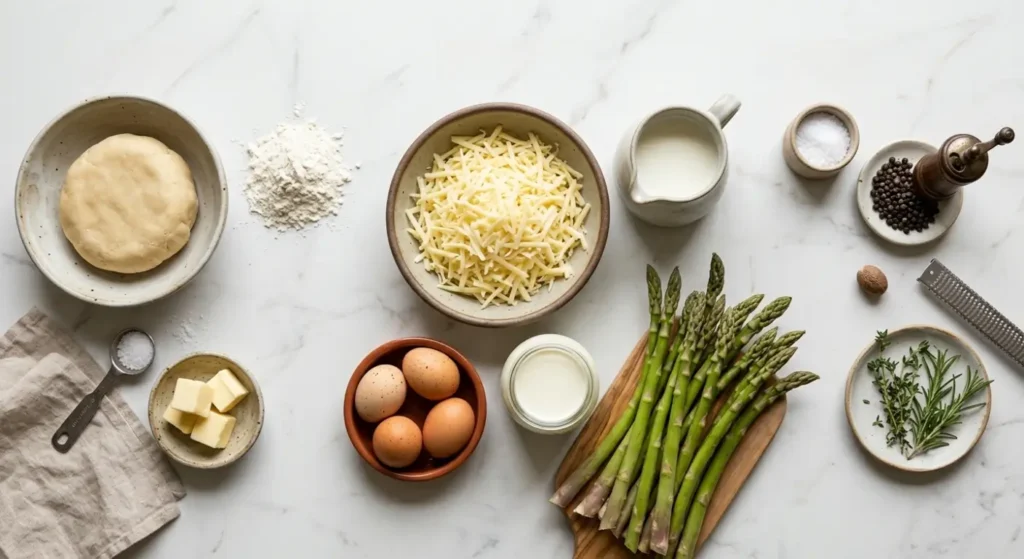
- 1 nine-inch shortcrust or all-butter pie crust
- 1 bunch fresh asparagus (about 300g / 10 oz)
- 1 cup Gruyère, grated from the block (about 100g)
- 3 large eggs
- 1 cup heavy cream (240ml)
- 1/2 cup whole milk (120ml)
- 1/2 tsp salt
- 1/4 tsp black pepper
- Small pinch of ground nutmeg
Gruyère comes young and aged. Young is milder, melts cleanly, slightly sweet — that’s what you want here. Aged Gruyère is nuttier and saltier; great on a cheese board, but it can throw off the custard seasoning. If that’s all you can find, taste the custard mixture before adding any salt. No Gruyère at all? Comté is the closest. Emmental works but it’s much blander.
Asparagus: firm stalks, tight tips. The cut end shouldn’t look dried out or shriveled. Avoid bunches with open, feathery tips — that’s asparagus that’s already past its moment. Medium-thickness stalks handle the oven better than thin pencil-spears, which go mushy fast.
Variations
The custard doesn’t change — 3 eggs, 1 cup cream, half a cup milk. Swap the filling however you want.
Leek and Gruyère. Slice two leeks thin and cook them slowly in butter for 20 minutes until soft and a bit golden at the edges. The winter version. Good alongside something bitter, like endive or arugula.
Mushroom and Thyme. Sauté 250g of mixed mushrooms with thyme until every bit of moisture has cooked off — takes 10 to 12 minutes, longer than you’d think. Mushrooms hold a huge amount of water. It all has to go. Good with roasted potatoes.
Smoked Salmon and Dill. Flake 150g of smoked salmon into the crust, add a tablespoon of fresh dill and some lemon zest to the custard, and skip the salt completely. The fish handles it. Serve this one at room temperature or barely warm.
Spinach and Feta. Wilt spinach, squeeze out as much water as possible in a clean cloth, use it with crumbled feta instead of Gruyère. Taste the custard before salting — feta is already quite salty on its own. Good with a tomato salad.
Caramelized Onion and Bacon. Two large onions, butter, low heat, 40 minutes. Don’t rush or they just go brown. Add 100g of cooked chopped bacon. Richest of the lot. Smaller slices than you’d think.
For any variation with vegetables that hold water — mushrooms, spinach, zucchini — cook them first, cool them, and make sure they’re dry before they go into the custard. Wet filling is the main reason quiche comes out loose.
Storing and Reheating
It keeps in the fridge for 4 days, sometimes longer if it’s well wrapped. Wrap it or put slices in a container. Cold quiche straight from the fridge is genuinely good — the custard firms up and the pastry has a denser texture I actually prefer. You don’t always need to bother reheating it.
For the freezer: cool it completely first, then plastic wrap followed by foil. Up to 2 months. Thaw overnight in the fridge before reheating — going frozen to oven cooks the edges before the center catches up.
Oven is the right way to reheat. Baking sheet, 325°F (165°C), 12 to 15 minutes. The crust gets crisp again and the custard warms evenly. If the edges start to brown, a loose piece of foil fixes it.
Microwave works in a hurry — 50% power, one-minute intervals. Full power makes the eggs tight and chalky. It’ll do the job but it’s not the same.
With leftovers I crumble a cold slice over salad greens with mustard vinaigrette; the pastry breaks apart like rough croutons. Or I put a fried egg on a reheated slice for a heavier breakfast than it looks. Cold quiche cut into small squares also holds up at room temperature for about an hour if you’re putting out snacks.
Common Questions
Do I really have to blind bake the crust? Without pre-baking, the crust absorbs moisture from the custard and never crisps. You get a pale, damp base that holds its shape badly when you slice it. The 25-minute upfront investment is worth it.
Can I make this the day before? This is how I almost always do it. Bake fully, cool to room temperature, refrigerate overnight. The next day it slices cleanly and the flavor is noticeably more settled. Reheat at 325°F for about 15 minutes.
Store-bought crust — is that fine? Half the time I use store-bought. All-butter shortcrust is fine and nobody will know. Thaw it completely before blind baking if it was frozen; different brands vary in thickness so follow the package directions rather than guessing.
What usually goes wrong? Two things that usually happen together: skipping the blind bake, then pulling the quiche out too early. The crust stays soft and the custard never fully sets. I’ve watched people cut into a quiche straight from the oven and wonder why it falls apart on the spatula. Blind bake properly, wait for the center wobble, rest it 15 minutes. That solves it.
Can I use a different cheese? Comté is the closest to Gruyère in both flavor and how it melts. Fontina is milder but works well. Sharp cheddar overpowers everything. Parmesan by itself clumps rather than melting into the custard — if you want to use it, mix it with Fontina rather than going solo.
There’s not much to this asparagus and Gruyère quiche once you’ve made it once. Spring asparagus — March through early June when it’s actually good — blind-baked crust, low oven, and patience before you cut it. Make it the day before if you can.